
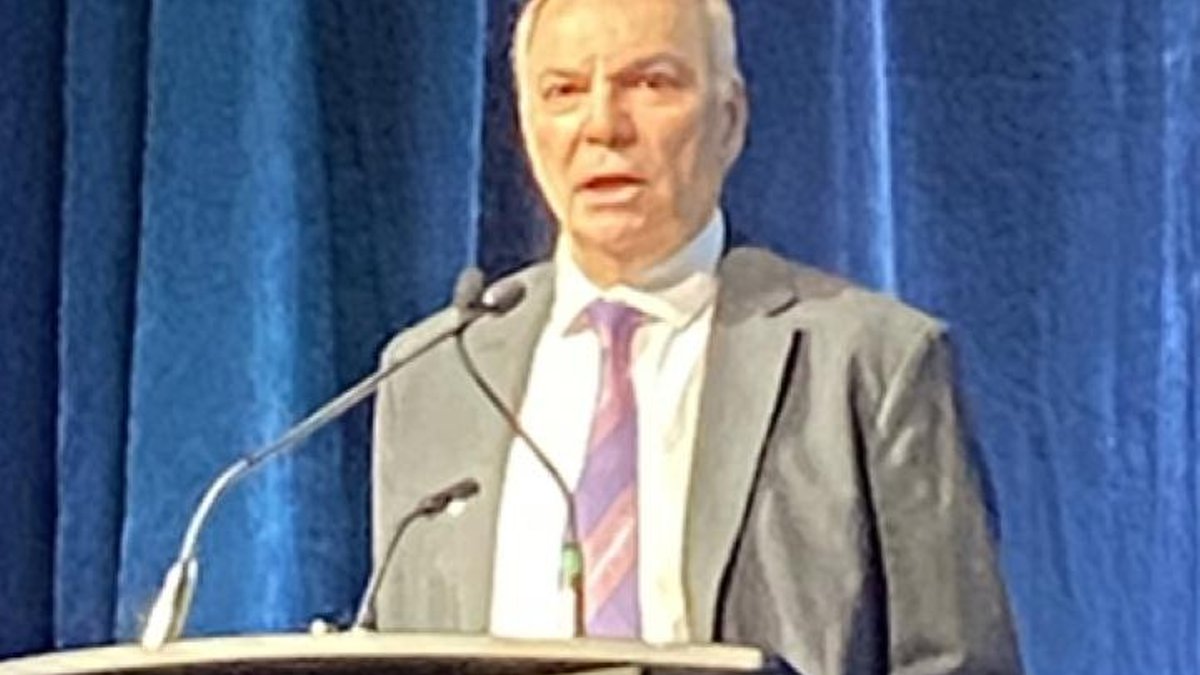
CIBC Capital Markets managing director and deputy chief economist Benjamin Tal delivered a stark but measured assessment of Canada’s economic outlook during the Canadian Apartment Investment Conference yesterday in Toronto. He began his remarks with a blunt admission: “The situation is not good,” framing the economic challenges as fundamentally illogical—yet one that demanded disciplined reasoning over emotional responses.
Tal’s remarks began with a direct challenge to the audience. “We are trying to make sense of something that does not make sense,” he stated, “and I believe that, as business people who make decisions on a daily basis, our only tool is logic. Can we fight this madness with logic? I say we have no choice because without logic we are lost. So we have to stick to some logical thinking, and I believe that logic will trump Trump.” He urged decision-makers to rely on reason rather than fear amid escalating trade conflicts, persistent inflation, and disrupted global supply chains.
The U.S. trade conflict with Iran and its tariff policies represent unsustainable pressures, Tal argued, though resolution may take longer than anticipated. “A resolution must be found and, while he doesn’t think it will be perfect and it will likely take longer than expected, he expects it to happen.” He noted that inflation in the U.S. currently stands at 3.5%, driven largely by tariffs and energy prices.
“Look what’s happening in the U.S., where inflation is 3.5 per cent because of tariffs and energy prices and the Fed, instead of cutting interest rates, may be raising interest rates despite what Trump is saying.” Tal emphasized that the Federal Reserve’s commitment to a 2% inflation target means long-term interest rates will remain raised in both Canada and the U.S.
Trade Wars Deepen Canada’s Economic Strain
Canada’s retaliatory tariffs against the U.S. were framed as a political response rather than an economic strategy, Tal warned. These measures risk deepening a “semi-recession” by adding inflationary strain, as they mirror the U.S. approach of “tariff madness”—a term he used to describe the broader trend of protectionism. The auto industry, already under pressure, faces a projected contraction of 10% to 15% even after trade agreements are finalized, while the forestry sector could suffer comparable losses. “The biggest impediment to ending the trade war is the auto sector,” he explained.
Tal’s examination of deeper economic forces painted a clear picture of permanent structural shifts. Deglobalization, the buildup of “just-in-case” inventories, tight labor conditions, and changes in immigration policy are all contributing to higher price levels, he argued. Fiscal policy and advancements in artificial intelligence are additional inflationary factors, creating a complex web of challenges for central banks. “A tariff is basically inflation with a passport,” he explained, illustrating how protectionist measures do not isolate exports—they permeate domestic pricing, forcing central banks to tighten financial conditions.
Housing Crisis Worsens Without Supply Solutions
The Canadian housing market, still recovering from four years of decline, would face further harm from rent controls, he cautioned. “The introduction, or re-introduction, of rent controls would be crazy,” Tal stated, warning that such measures would worsen affordability without addressing the root causes of supply shortages.
Among the few positive developments, Tal highlighted Canada’s infrastructure investments as a vital economic stimulant. “Canada is correctly making major investments in infrastructure across the country to ‘add oxygen to the economy,’” he noted, emphasizing that these measures will expand productivity and economic growth. While he advocated prioritizing health and education spending, he acknowledged that strategic defense investments could also enhance productivity—provided funds are allocated efficiently. Diversifying the Canadian economy and making it less reliant on the U.S. is “admirable, but very difficult to do.”
Mortgage rates have stabilized, which should gradually unlock consumer spending as uncertainty diminishes. “Mortgage shock is over,” Tal observed, suggesting that households will regain purchasing power once economic clarity returns. Immigration remains essential for population growth, but Tal stressed that annual arrivals of 350,000 to 400,000, roughly 1% of Canada’s population, represent a sustainable level. The sharp rise in immigration between 2023 and 2024 was followed by a correction, yet the rental market could stabilize if intake levels balance supply and demand. “Your industry can do extremely well in this environment,” he told attendees, provided policymakers avoid counterproductive measures like rent controls or reckless trade barriers.
Rental Market Shows Early Signs of Recovery
For investors in Canada’s apartment sector, the near-term prospects are not bleak, Tal assured. After years of stagnation, the market appears poised for a turnaround. “When it comes to the housing market and the rental market, I think that, after four years of correction and slowdown, we are starting to move in the right direction,” he said, attributing this shift to stabilizing mortgage conditions and a more balanced approach to immigration.
Tal anticipates the next six months will be a transition period but, for the rest of 2027 and 2028, he thinks Canada will be in a stronger overall position than it’s in now. The auto industry’s projected decline and risks to the forestry sector show the toll of prolonged trade disputes, yet his focus on infrastructure and immigration signals confidence in Canada’s capacity to adapt. The rental market, in particular, may finally achieve stability after years of instability, provided immigration levels remain within sustainable ranges. “Almost all of Canada’s population growth is coming from immigration,” he remarked, showing the need for careful management to avoid supply-demand imbalances in housing.
For now, the economy remains in a transitional phase. Tal’s central message was unequivocal: structured thinking will shape the future, not unchecked volatility. “We have no choice but to stick to some logical thinking, and I believe that logic will trump Trump.” He concluded by emphasizing the need for disciplined economic management in an uncertain environment.


